I built a World Cup prediction machine (and bet real money on it)

I built a World Cup prediction machine (and bet real money on it)
The 2026 World Cup kicked off tonight at the Azteca. Two days ago, this project was a JSON file with 48 country names in it - ten of which, it later turned out, hadn’t even qualified. Tonight it’s a live site with a statistical model, 100,000 simulated tournaments, real money on the line, and a bracket that’s locked and publicly graded against the betting markets.
This post is about what got built, what the data refused to believe, and what it’s like to build something like this with an AI pair programmer.
What it is
The Form Book is an open-source research tool (code on GitHub) that:
- fits a Dixon-Coles goal model - the 1997 system professional odds compilers still build on - to 8,081 international matches, weighted by recency, with hyperparameters chosen by cross-validation rather than vibes
- adds a squad-value prior from Transfermarkt market values, because goals data can’t see that France’s quiet year happened without their stars
- simulates the entire tournament 100,000 times over a 200-model bootstrap ensemble, on the official FIFA bracket, with injury/fatigue randomness baked in
- compares every probability against live Polymarket prices and highlights where the model and the crowd disagree
- placed 42 real bets through Polymarket’s API, sized by fractional Kelly under hard caps, with a ledger that makes overspending impossible
- locked the full bracket before kickoff - all 72 group matches and every knockout round to the champion - and grades itself in public as results land
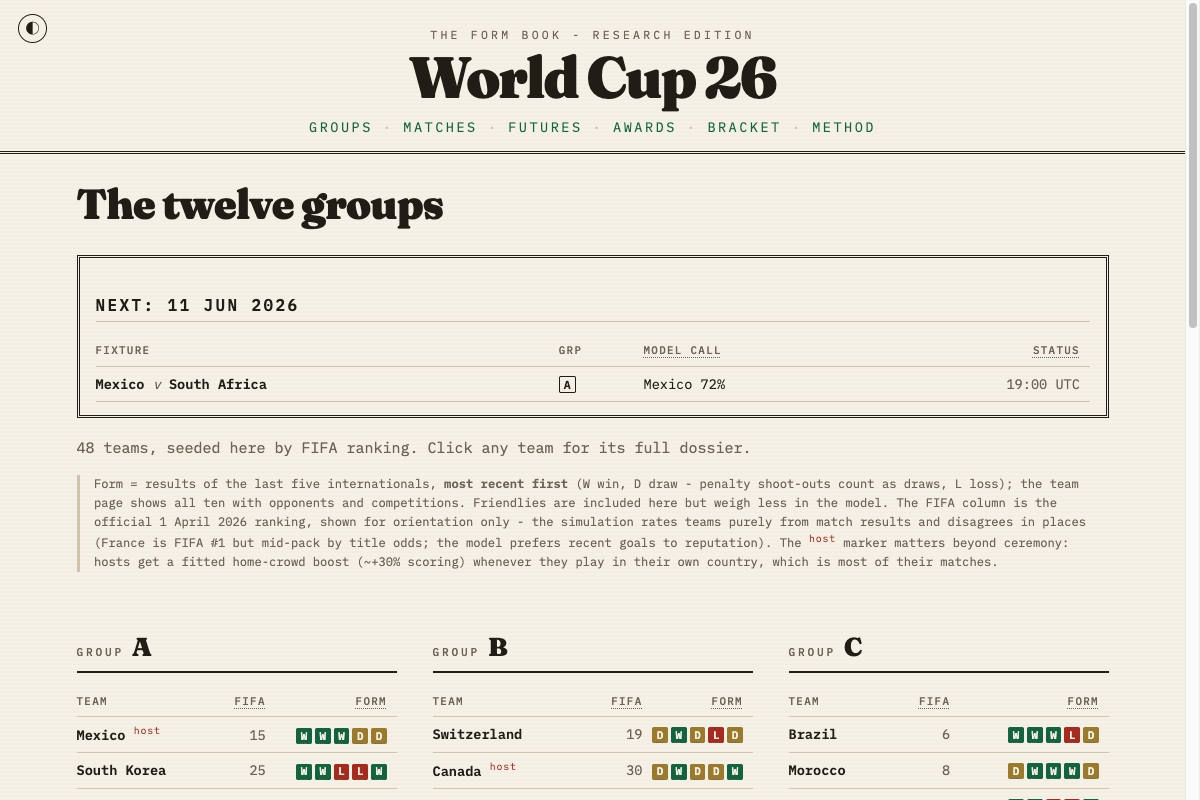 The site a few hours before kickoff: the model calling the opener at 72% for Mexico.
The headline predictions, frozen before a ball was kicked: Argentina beat Spain in the final, Kane and Jonathan David share Golden Boot favouritism, and the model thinks the market is sleeping on Japan.
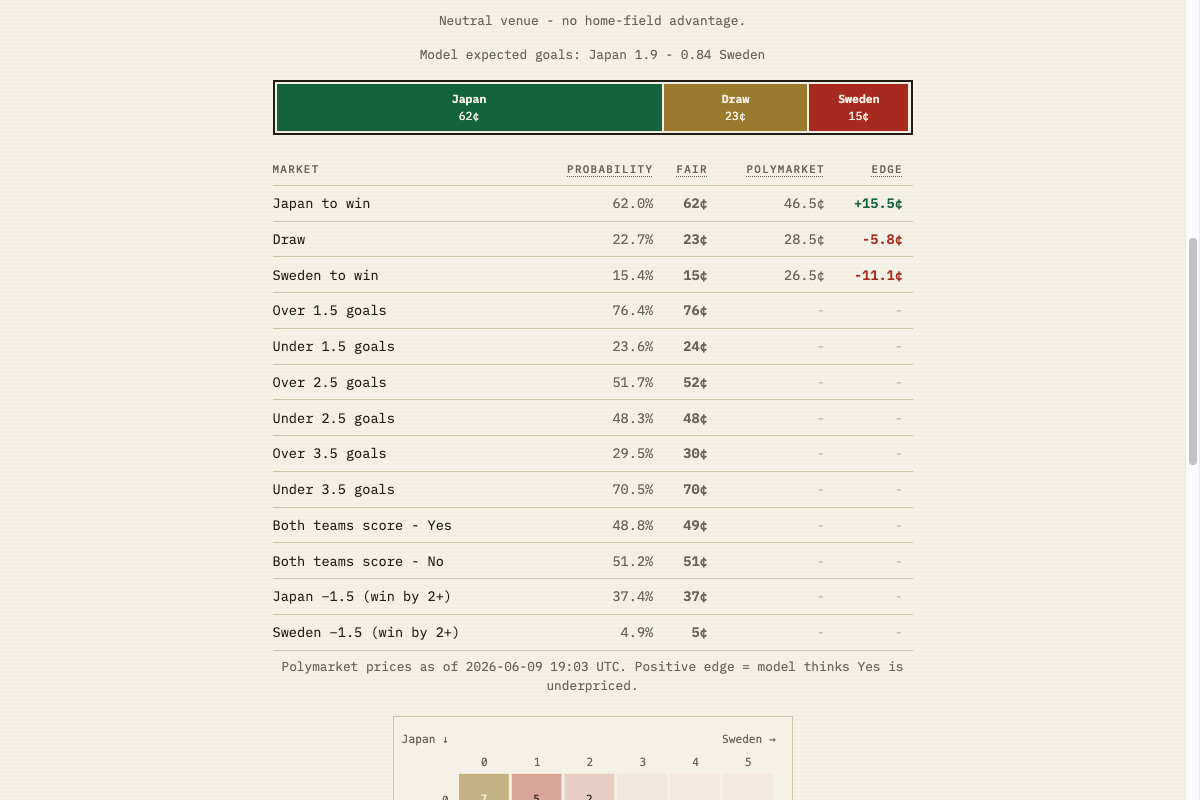 Every match gets a card like this: the model’s fair prices against live Polymarket
quotes, and a heatmap of every possible scoreline. This one is Japan v Sweden -
the model’s favourite disagreement with the market.
Every match gets a card like this: the model’s fair prices against live Polymarket
quotes, and a heatmap of every possible scoreline. This one is Japan v Sweden -
the model’s favourite disagreement with the market.
The parts I didn’t expect
The data fought back. We cross-checked 480 recent match records against an independent dataset and found four wrong scores - then proved the reference dataset was the wrong one in all four cases, and patched it at load time. Later, a failing unicode lookup unraveled into the discovery that our squad data was missing ten teams, which explained why Erling Haaland had silently never appeared in our Golden Boot odds. The moment his data existed, the model priced him within half a cent of the betting market. I have never trusted a bug fix more.
The data also said no. Two reasonable-sounding ideas - capping blowout scorelines, using shorter memory - lost to the validation set and were rejected. One fashionable idea (player market values, borrowed from Nate Silver’s approach) passed spectacularly: held-out log-loss improved from 0.854 to 0.818, the single largest gain in the project. The rule that made this work: nothing ships without beating the holdout. Not even good ideas. Especially not good ideas.
Honesty is a feature you can build. Every prediction is written down before the event. Every calculation run is archived with a timestamp. Old versions of the site are frozen daily and browsable. The scorecard grades the model, the market, and the blend separately with proper scoring rules - so by the group stage’s end, the data itself will say which forecaster deserved trust. A prediction you can revise afterwards isn’t a prediction.
Built with Claude
I did this project with the help of Claude (Anthropic’s Fable 5 model) running in Claude Code. The honest division of labor: I brought the idea, the API keys, the betting account, and a steady supply of “wait, is that right?” - Claude wrote the pipeline, ran the validations, caught most of its own mistakes, and occasionally caught mine.
What surprised me wasn’t the code generation - it was the skepticism. The parts of this project I trust most came from adversarial moments: the model audit that out-argued a reference dataset, the validation harness that killed features we both liked, the calibration chart that exists specifically so readers don’t have to take anyone’s word for anything. At one point someone on Twitter told me to stop letting AI build my model and use a credible source instead. The model’s reply was to put its out-of-sample numbers on a public methodology page next to a falsifiable, locked bracket. That page is here - it even has a Farsi version.
What happens now
The tournament runs through July 19. Every matchday: results come in, the model refits, the site rebuilds, a snapshot freezes, and the scorecard updates. Either the machine beats the crowd or it doesn’t - and either way, the answer will be sitting on a public webpage with my name on it.
None of this is betting advice. The model knows nothing about injuries, lineups, or what the coach said at breakfast. Stakes were sized so that losing all of it costs less than a decent dinner out.